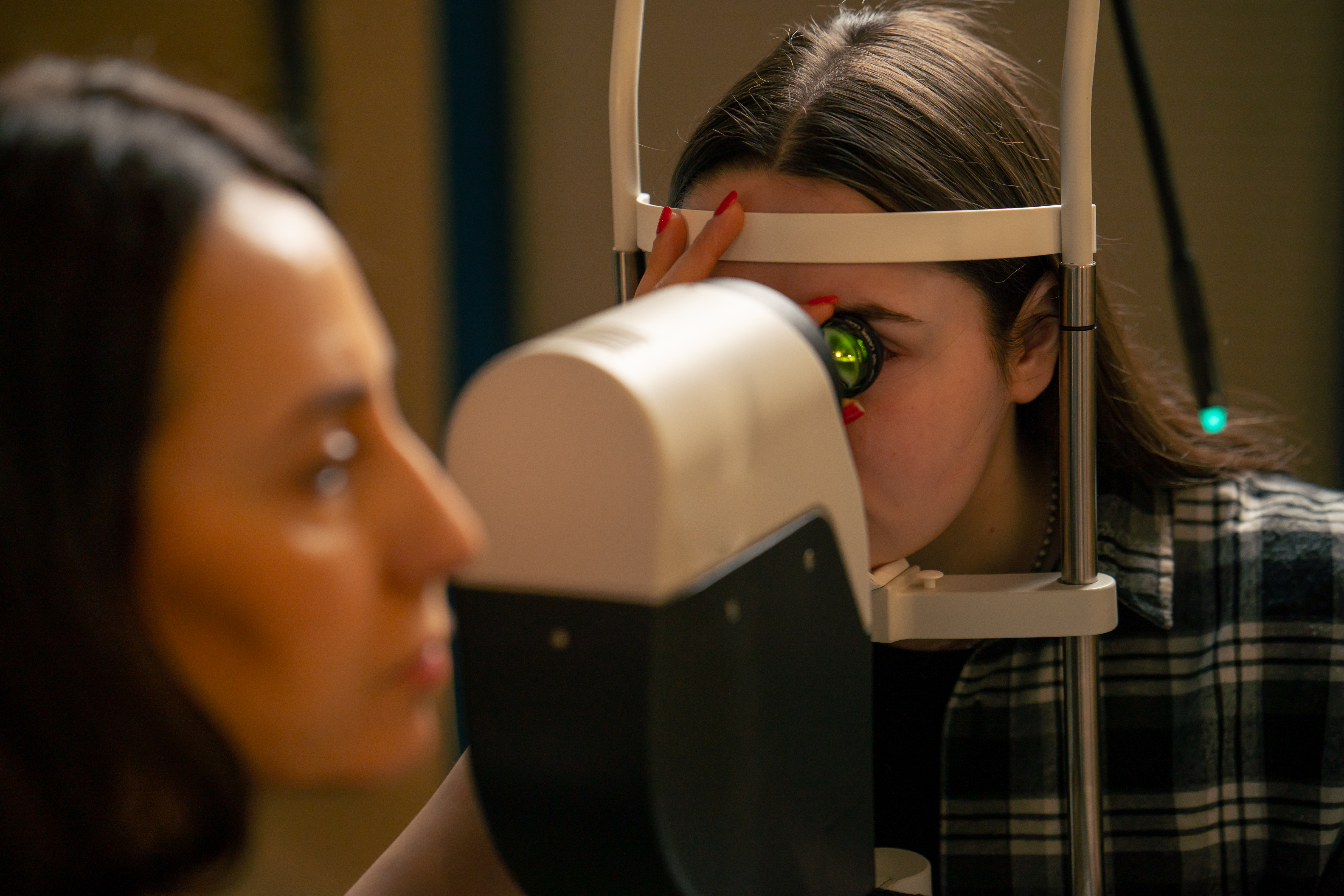
Glaucoma, also known as the “green star,” is a sneaky and often painless disease that can cause permanent blindness if left untreated. In our Frankfurt clinic, glaucoma screening is a key preventive measure to protect your vision. Dr. Mareen Schmidt in Westend uses the latest gentle diagnostic methods to detect this gradual condition early and help preserve your eyesight.
Glaucoma is not a single disease but a group of eye conditions that share one feature: they cause progressive and irreversible damage to the optic nerve. The optic nerve acts like a cable, transmitting all visual information from the eye to the brain. When its millions of nerve fibers are damaged, gaps appear in the visual field. These vision losses usually start at the edges, while central vision remains intact for a long time. Because of this, people often notice the disease only in its advanced stages. Effective glaucoma screening is essential to stop this “silent thief of sight” early.
Comprehensive glaucoma screening at our Frankfurt practice involves more than just a basic measurement. It combines several complementary components that together provide an accurate assessment of your optic nerve health and your personal risk.
Intraocular pressure measurement (tonometry) is essential since elevated eye pressure is the main risk factor for glaucoma development. We perform this test gently and without touching your eye. Our devices are FDA-approved.
Examining the optic nerve head (ophthalmoscopy) is done by Dr. Mareen Schmidt using a specialized microscope. This allows early detection of typical glaucoma changes, such as increasing excavation where the optic nerve leaves the eye.
Measuring corneal thickness (pachymetry) is important because it affects the accuracy of the eye pressure reading. By determining your cornea’s thickness, we can adjust the pressure value and provide a more precise evaluation.
Although glaucoma screening is generally recommended for all adults over 40, certain high-risk groups should have earlier and more frequent check-ups.
In eyes with severe nearsightedness, the optic nerve is more vulnerable to pressure damage.
The risk increases significantly starting at age 40.
The main risk factor.
If your parents or siblings have glaucoma, your own risk of developing the condition increases significantly.
The following table provides an overview of the main methods and their contributions to diagnosis.
Procedure | What is being measured or evaluated? | Why is glaucoma prevention important? |
Tonometry | Intraocular pressure. | Identify the most significant treatable risk factor. |
Ophthalmoscopy | The appearance and shape of the optic nerve head. | Allows direct visual identification of common glaucoma damage. |
Pachymetry | The thickness of the cornea. | Improves the accuracy of measuring intraocular pressure. |
OCT | The precise thickness of the nerve fiber layer. | It detects early structural damage years before other tests and allows precise monitoring of its progression. |
Glaucoma screening relies on a combination of specific tests, each providing important information for detecting and monitoring the disease.
Measuring and Assessment
Tonometry measures the intraocular pressure, which is the most important treatable risk factor for glaucoma. Since increased eye pressure can damage the optic nerve, this measurement is essential.
At the same time, ophthalmoscopy allows the eye doctor to visually examine the appearance and shape of the optic nerve head. This test is crucial because it helps identify typical glaucoma damage that may already be present.
Eye care professional societies recommend regular glaucoma screenings for everyone starting at age 40. If risk factors are present, especially a family history, the first examination should take place earlier. Starting screenings early provides the best protection.
No, none of the tests involved in glaucoma screening cause pain. The modern method for measuring eye pressure uses a gentle air puff and does not require any contact. The OCT examination is a scanning procedure where you only need to look at a fixation light. Our gentle approach is part of our commitment to quality.
No, there are significant differences in quality and function. Choosing the right eye drops is essential for effective treatment. First, it is important to use preservative-free drops because preservatives can irritate the eyes and damage the surface with long-term use. Additionally, the active ingredient must match the cause of your dryness.
Wässrige Tropfen (z.B. mit reiner Hyaluronsäure) helfen vor allem bei einem Mangel der wässrigen Phase (hypovolämische Form).
Lipidhaltige Tropfen enthalten zusätzlich eine Öl-Komponente und sind bei der weitaus häufigeren evaporativen Form (Meibom-Drüsen-Dysfunktion) notwendig, um die schützende Lipidschicht zu stabilisieren und die Verdunstung zu reduzieren. Wir beraten Sie individuell, welches Produkt optimal ist.
The recommended interval for glaucoma screening depends on your age and individual risk factors. If results are normal and risk is low, a check-up every two years is sufficient. However, if there are increased risks or borderline findings, yearly examinations are advisable to detect any changes early.
Yes, this is a very important point. There is a type of glaucoma called "normal-tension glaucoma" where the optic nerve is damaged even though the eye pressure remains within the normal range. Therefore, measuring eye pressure alone is not sufficient for reliable glaucoma screening. Evaluating the optic nerve is always the crucial factor.
An unusual finding during glaucoma screening is not a reason to panic but an opportunity to act early. Dr. Mareen Schmidt will discuss the results with you in detail. Usually, a visual field test (perimetry) follows to check for any functional impairments. If the diagnosis is confirmed, treatment with eye drops can stop or significantly slow down the progression of the disease in most cases.
The most important step is to attend regular glaucoma screenings since you cannot feel any symptoms yourself. Maintaining a healthy lifestyle with consistent exercise and proper control of blood pressure and blood sugar levels helps support blood flow to the optic nerve. Still, early detection by an eye specialist remains the key to protecting your vision.
For a thorough evaluation of the optic nerve head during glaucoma screening, pupil dilation with medication is often beneficial. Whether this is necessary depends on your individual anatomy. Thanks to our advanced OCT technology, we can frequently perform a very accurate analysis of the nerve fiber layer without the need for dilation drops.
These two conditions are often confused. Glaucoma, also known as Green Star, affects the optic nerve and is the main focus of glaucoma screening. Cataract, or Gray Star, is a clouding of the eye’s lens that causes blurry vision but can be completely cured through surgery. In contrast, damage caused by glaucoma is permanent and cannot be reversed.
At Dr. Mareen Schmidt's practice, you receive top-level glaucoma screening. We use advanced technology such as optic nerve OCT alongside the expertise of a specialist. Our careful and gentle 5-S-method ensures an examination that is both accurate and comfortable. Your eyesight is in excellent hands with us.
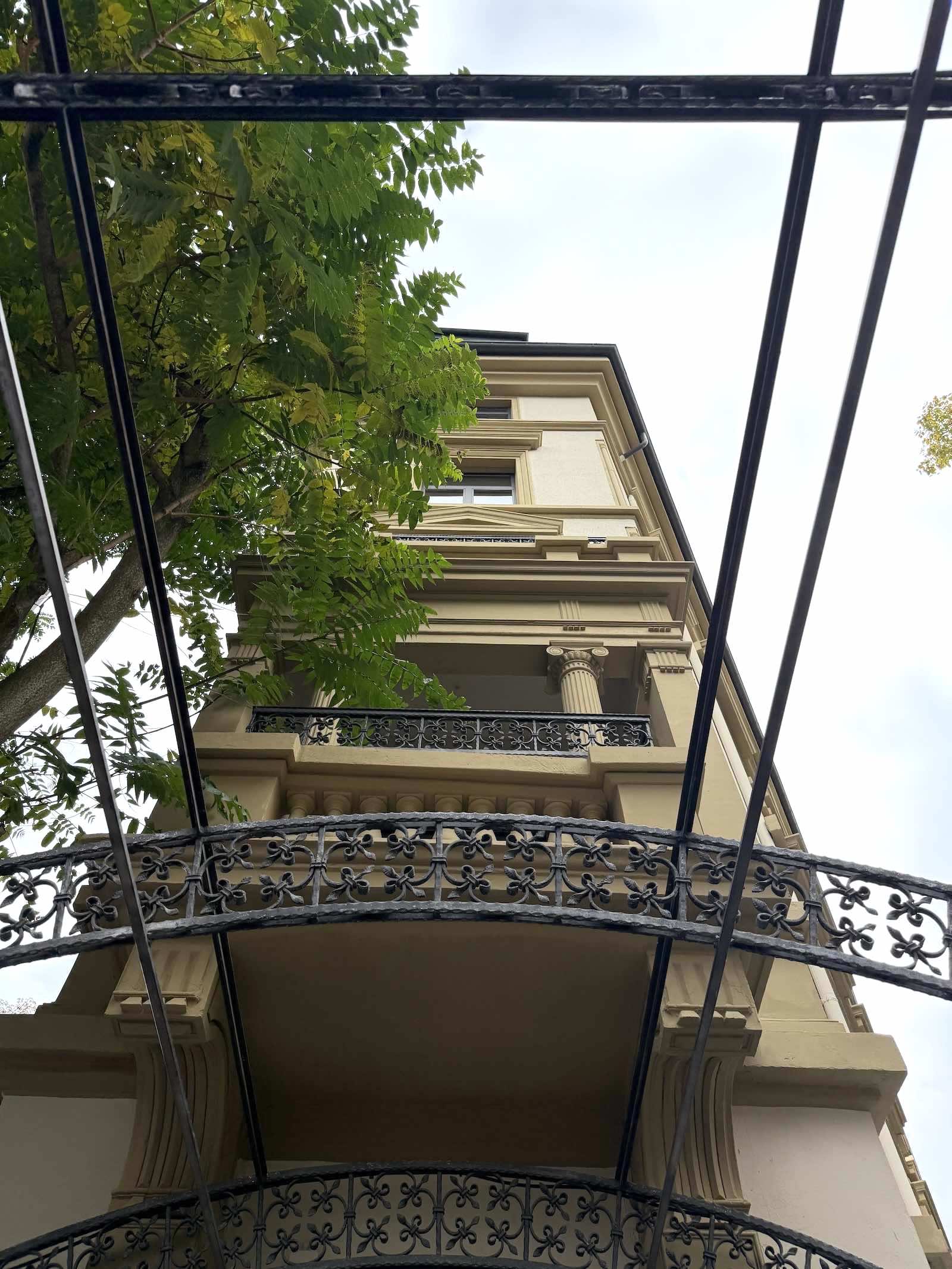


As your eye specialist in Frankfurt, Dr. med. Mareen Schmidt combines extensive clinical experience as a senior physician in the Clinic for Retinal Diseases with over 10,000 intraocular procedures, including IVOM, laser treatments, cataract surgeries, and vitreous body surgery. She uses the most advanced diagnostic methods to provide care based on scientific evidence and proven ophthalmology. In her practice in Frankfurt’s Westend, she focuses on precise diagnosis and offers personal, trustworthy consultations with the patient at the center of her care.
Dr. med. Mareen Schmidt wurde das BDOC-Gütesiegel verliehen. Das „BDOC-Gütesiegel Augenchirurgie“ wurde vom BDOC als Qualitätszertifikat für Augenchirurgie entwickelt und wird ausschließlich an versierte Augenoperateure verliehen.
Using advanced diagnostics and proven therapies to preserve your vision for a lifetime.
Build a trusting doctor-patient relationship and carefully protect your eyesight.